Hybrid vehicles attempt to strike a balance between the more versatile
combustion engine and the more economical electric motor. A number of different
options exist, and this article attempts to simplify the technology and
highlight the differences between modern hybrid systems.
Hybrid technology comparison
| Hybrid type |
| Integrated electric motor |
Engine / motor axle split |
Extended range electric vehicle |
 |
 |
 |
| Also known as |
|
|
|
|
| Advantages |
- Most conventional car-like option
- Compact
|
- Allows larger engine / motor variants to be used
- Allows usage in high performance cars
|
- All the efficiency benefits of electric propulsion without
a compromised range
- Quiet at all speeds and engine loads
|
| Disadvantages |
- More expensive than an efficient petrol or diesel
option
|
- Reduced usable space
- Complex synchronisation is required between motor and
engine
|
- Reduced usable space
- Reduced top speed versus combustion powered
equivalents
|
| Variants |
- Plug-in / stand-alone
- Petrol / Diesel
- Start-stop
|
- Single motor
- Dual motors
- In-wheel motors
- Plug-in / stand-alone
- Petrol / Diesel
- Start-stop
|
- Single motor
- Dual / quad motors
- In-wheel motors
- Plug-in / stand-alone
- Petrol / Diesel
- Start-stop
|
| Examples |
- Toyota Prius
- Honda Insight
|
- Porsche GT3 Hybrid
- Honda NSX
- Infiniti Emerge
- Peugeot 3008
|
- Chevy Volt
- Vauxhall Ampera
|
Electrically assisted hybrid cars
[Sometimes known as parallel hybrid cars]
If a car contains both a combustion engine and electric motor, it is
unlikely that the electric power will be used as their dominant source of
propulsion for high speed cruising. To gain maximum efficiency benefits, the
challenge for designers is to ensure that the electric motor can contribute
when the greatest benefits can be realised.
Fully integrated
Fully integrated hybrids combine conventional engine and electric motor
outputs into a single source. The electric element of the powertrain assists
the engine when required but is not essential for progress to be made. The
motor usually kicks in when pulling away or when an extra burst of acceleration
is required. A 'start-stop' feature is usually employed on the main engine, and
this allows maximum efficiency when driving in city conditions. Early hybrids
were exclusively petrol due to the relatively quick and easy engine start
associated with this fuel, but diesel hybrids are likely to become more common
in future as this issue is tackled. Power is provided by a bank of batteries,
which is recharged by making use of excess powertrain energy (such as when
slowing down, coasting or braking).
Diagram 1: Integrated hybrid (front wheel
drive)
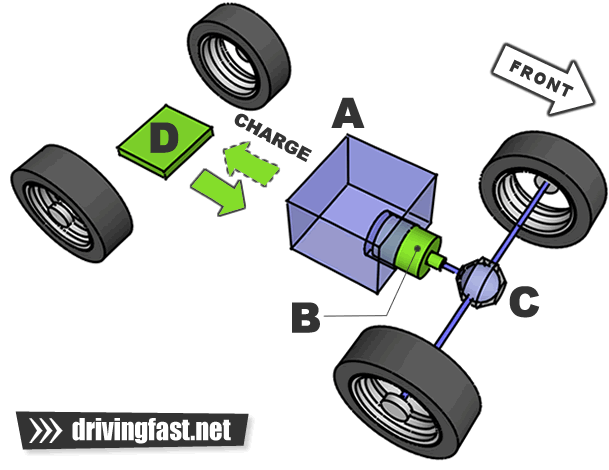 A
A. Petrol or diesel engine
B. Integrated electric motor
C. Differential
D. Battery bank
Integrated hybrid technology is often used for the more affordable end of
the market due to the relative simplicity and user friendliness of these
systems. Pioneers of the technology include Toyota and Honda.
Examples of integrated hybrid cars:
| Honda Hybrids [e.g. Insight,
CR-Z] |
 Honda Integrated Motor Assist
 |
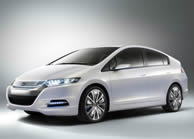 Honda Insight
 |
| Toyota Hybrids [e.g. Prius,
Auris] |
 Toyota Hybrid Synergy Drive
 |
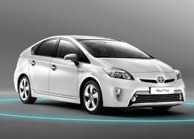 Toyota Prius
 |
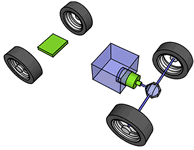
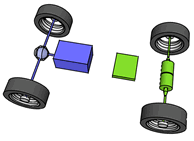
Engine / motor split by axle
The second natural method of creating a hybrid powertrain is to split the
electric motor and the engine by axle. Hybrids with a dedicated electric axle
have a number of potential layouts:
- A single motor and differential to split the drive to both wheels
- Dual inboard motors, with computer controlled variable speed control
(shown in diagram 2 below)
- Dual in-wheel motors
Advantages of the split layout include the ability to power all four wheels
simultaneously, to reduce packaging complexity, and to use a larger engine /
motor combination. Most hybrid supercars use this layout, usually with the
engine driven wheels at the rear.
Diagram 2: Electric motor powered front axle, combustion
engine powered rear wheels
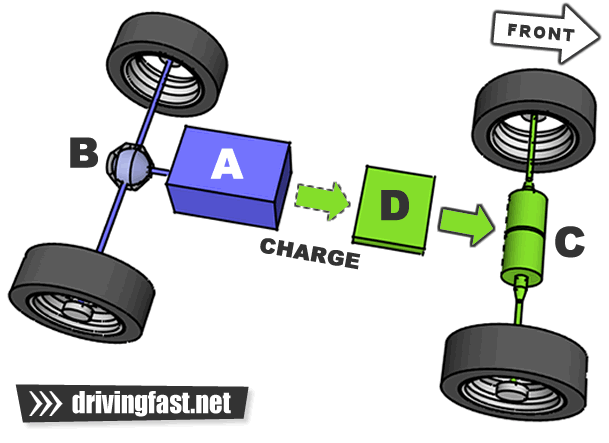 A
A. Petrol or diesel engine
B. Differential,
C. Electric motor (or dual motors in this case)
D. Battery bank
The dual motor technology shown as an example in Diagram 2
is more complex and expensive to produce, and is only likely to be realised in
higher performance hybrids or electric vehicles. Some examples of the
application of dual high performance electric motors are shown below.
high performance hybrid supercars
A new generation of hybrid supercars are now emerging - a strategy primarily
driven by tough new emissions legislation applied both to road cars and in
racing. To satisfy the traditional sports car owner, most high-performance
hybrids will maintain conventional power at the rear axle to deliver a sporty
feel and top speed performance, so the natural use of the electric motor will
be to contribute at the front. As the technology has advanced, the idea of
hybrid sports cars has become more appealing due to the fact that electric
motors have the benefit full torque available immediately. When applied
correctly, this can help fill the flat spots in a conventional engine's power
curve and improve relative performance. The challenge for manufacturers is to
overcome the weight disadvantages associated with the high output battery packs
required for these products. Expect to see hybrid systems appearing in many
more high-performance cars as the technology improves.
High performance hybrid / electric examples:
| Mercedes SLS AMG E-Cell |
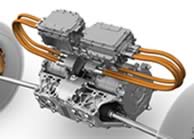 Mercedes
E-Cell SLS dual motor electric drivetrain Mercedes
E-Cell SLS dual motor electric drivetrain |
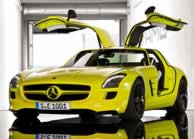 Mercedes E-Cell SLS exterior
 |
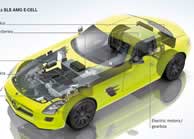 Mercedes SLS E-Cell powertrain
 |
| Porsche 911 GT3 Hybrid |
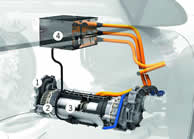 Porsche 911 GT3 electric motors
 |
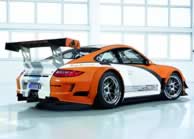 Porsche GT3 Hybrid exterior
 |
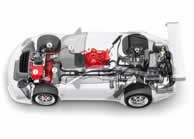 Porsche GT3 Hybrid powertrain
 |
| Honda / Acura NSX |
|
Infiniti Emerge |
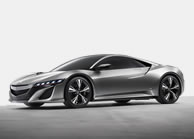 The Honda NSX has a split axle hybrid powertrain
 |
|
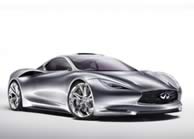 The Infiniti Emerge uses split axle hybrid technology
 |
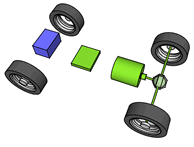
Extended range electric vehicle
[Sometimes know as 'series' or range extended hybrid cars]
Engine assisted hybrids vehicles use an electric motor as the sole source of
drive, so these are essentially electric vehicles. However they address the
range constraints of a typical electric car by using a more conventional
combustion engine when required to recharge the batteries and extend the life
of the batteries. The engine is never used to directly power the wheels, and
this means it can operate in the most efficient conditions to maximise
economy.
Diagram 3: Range extended electric vehicle
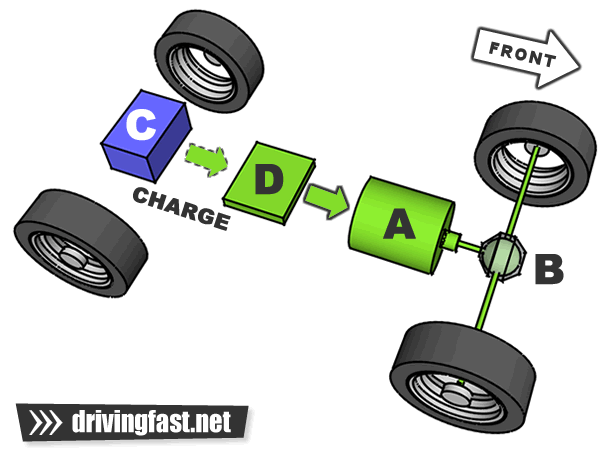 A
A. Electric motor as the primary source of propulsion
B. Differential
C. Engine / generator
D. Battery bank
Range extender hybrid examples:
Chevrolet's range extender hybrid
| Volvo range extender hybrid |
|
Regenerative braking
Regenerative braking is an energy recycling method used on most hybrid and
electric cars. The idea is to convert the kinetic energy (which is usually lost
as heat during braking) into usable electricity to recharge the battery pack.
Energy is usually captured by using the main electric motor in reverse (as a
generator), which is connected to the wheels automatically when braking is
started. The Porsche GT3 hybrid uses a high speed flywheel to store captured
braking energy, when is then released on demand to power the motors.
hybrid Glossary
- EREV - Extended Range Electric
Vehicle
- Full hybrid - the ability to run on either the engine,
the electric motor, or a combination of the two
- Mild hybrid - a car which cannot be powered by the
electric motor alone
- Parallel hybrid - both the engine an motor are
connected to the transmission which powers the wheels
- PHEV - Plug-in hybrid electric vehicle (can be charged
by plugging-in)
- Series hybrid - only the electric motor can drive the
wheels, the engine simply charges the batteries

 Mercedes
E-Cell SLS dual motor electric drivetrain
Mercedes
E-Cell SLS dual motor electric drivetrain Mercedes E-Cell SLS exterior
 Mercedes SLS E-Cell powertrain
 Porsche 911 GT3 electric motors
 Porsche GT3 Hybrid exterior
 Porsche GT3 Hybrid powertrain
 The Honda NSX has a split axle hybrid powertrain