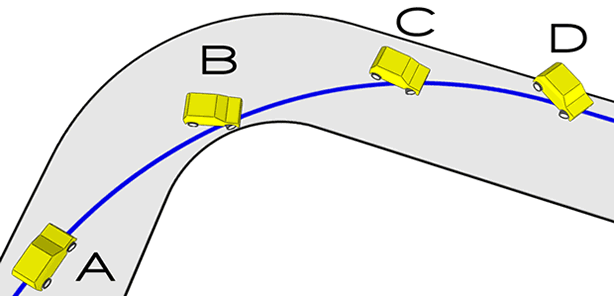
The racing line is the route a racing driver follows in order to take corners in the fastest possible way. By using all of the available space on the track, cars can travel in a straighter line and travel faster before reaching the limits of grip. Determining the best line is an essential skill to master for both track days and racing events.
The best line depends on the following factors:
- Braking point
- Turn in point
- Apex
- The position and direction of the next corner
It is important to remember that there is rarely a perfect line through any corner for all circumstances. It depends on the characteristics of your car, your cornering strategy and the conditions. If you may also have to react to the position of other cars on the track. You should experiment with different lines and learn from instructors and people who know the course well.
Braking point
How good are your brakes? How quickly can you reduce your speed from 100mph to 40? How does your car behave when the front wheels are locked? How brave are you feeling? All these factors determine your braking point. It's a sensible strategy to brake earlier when you're learning the track and your car, and progressively shorten the braking area as your experience grows. The rule of thumb is to get most of the braking out of the way before turning into a corner, although a slight brake pressure on entry can help to reduce understeer and can give a better turn in (this is known as trail braking). Threshold braking is the technique you should aim for, but if the wheels do lock, quickly ease off and reapply the brakes with slightly less pressure until you get it right. Try not to turn in if any of the wheels have lost traction.
Turn-in point
To get the line right, it is vital to turn in at the correct point. Leave it too late and you'll miss the apex, too soon and you'll have to tighten your line mid corner. Get this right and you'll have set yourself up for a good line. Remember that the apex may be further round the turn than you can see, so make sure you learn the track and the apex points before driving in anger. On track days, there are often cones on the track to help new drivers learn the track - but even when the cones are gone there are often visual clues which you can use, a good instructor will be able to help you find them.
Apex
The apex is the point at which you are closest to the inside of the corner, also referred to as the clipping point. Once you have hit the apex you will be able to reduce the steering lock and increase the throttle. Determining the apex can be tricky but the guidelines below explain how to do it.
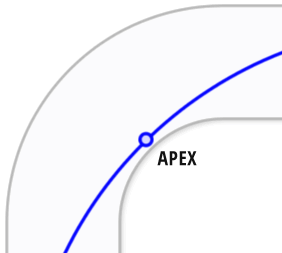
There are two different types of apex, the geometrical apex and the racing apex. The geometric apex of a constant radius corner is the central point on the inside and this may also be the racing apex, which depends on the context. Confusing! This is where your strategy comes into it, especially when you're racing. There are two main strategies for cornering:
- Minimising the severity of the turn and carrying speed through the corner (great for less powerful cars or when driving in the rain)
- Getting the power on early for a faster exit speed (great for powerful cars and when racing)
The geometric apex - carrying speed and minimising the turn severity
To carry maximum speed through a corner, you need to take the route that minimises the tightness of the corner arc. This minimises cornering force and frees up precious grip for maintaining speed. This route tends to use the geometric apex of the corner and is usually known as the classic racing line. In Diagram 1, the turn illustrated is a constant radius 90 degree right hander and the geometric apex is exactly halfway around the corner.

Advantages of the classic / traditional line:
- Smooths out corners in the most efficient way
- Maintains momentum (can be useful for low powered cars)
- Reduces the chances of understeer or oversteer (especially helpful in the rain)
- Preserves the life of tyres
Disadvantages:
- Not necessarily going to yield the fastest possible lap times
Late apex - getting the power on early
Oddly enough, carrying the highest average speed round corners may not actually be the quickest way around a track. If the corner leads onto a straight it can be better to take a late apex, straighten out the car and get the power on earlier for a high speed exit (Diagram 2). This is generally regarded as the best strategy for racing, with a slightly lower entry speed but a faster exit speed. The amount of grip available is the factor which determines how late you can brake and apex.

Advantages of the modern racing line:
- Increases the chances of a fast lap in a powerful car
- Allows the power to be applied earlier
- Maximises the use of any straights following the corner
- Allows late braking
Disadvantages:
- May not be the fastest route in a low powered car
- Places greater demand on the tyres
Common mistake:
It's very common for drivers to apex too early due to nerves about the approaching corner and eagerness to take the turn. The racing line apex which is often out of view at the point of turn in, or further round the corner than you expect (see Diagram 3 below). This is where experience and track knowledge come in.

Hairpins
A hairpin is a corner which turns about 180 degrees. In this case, the apex for the racing line is about three quarters of the way around the bend (see Diagram 4). A useful guide is that halfway through the turn you should be roughly in the middle of the track.

The position of the next corner
The position and direction of the next corner also affects the choice of line. For example, if the next bend is a left hander you'll need to move over to the right hand side of the track, and thus will need to apex later and take a tighter, slower line. However, if the next corner is another right hander a wider, faster arc can be used (see Diagram 5).

to illustrate the points covered in this article, take a look at this short clip from the MotoGP, where you can clearly see the racing line the bikers are taking on the wet track.
Now that you know the fastest line through a corner, it's time to learn how to drive corners competitively.