In every discipline from drifting to racing, aggression does not equal speed. If you only learn one skill to improve your driving technique it should be the art of smooth driving. On the track, driving smoothly allows you to minimise weight transfers, make the most of every last bit of grip, and maintain control at higher speeds. On the road it makes the drive more comfortable for your passengers and can even increase fuel economy. Remember, if you're driving at only 50% of the car's potential, you'll be able to get away with changing gear roughly and braking, accelerating and steering aggressively. But when you're driving near your car's limits these actions can lead to loss of traction, poor track times and increased risk of an accident. It's important to get into good habits even if you're not travelling at breakneck speeds.
Steering
Shuffling your hands is not a smooth technique
When driving on the track, hold the steering wheel at the ten to three position (Diagram 1) to allow fairly tight radius corners to be tackled without having to take your hands off the wheel. If your car requires a large number of turns from lock to lock you should reposition your hands on the wheel accordingly before taking a tight bend. Shuffling your hands is not a smooth technique.
Dedicated article on steering technique

Graph 1 below plots the grip demands on the two front tyres which result from turning a simple corner (ignoring other forces). In this case, the driver does not approach the limits of grip at any point as a result of steering. When turning a corner, there is usually a spike in force as the weight transfers to the outside of the car, and it's at this point loss of traction is most likely to occur. Grip demands then remain relatively constant for the duration of the corner, then reduce as the steering lock is unwound. Once the car is straight, there is usually an additional small spike in force as the weight transfers to the opposite side (this is known as the pendulum effect).

The lessons to take from the graph are as follows:
- Avoid 'chucking' the car into a corner - ease it in, allowing the weight to shift to the outside of the car in a progressive manner. Spikes in force need to be avoided when driving near the limit.
- Do not place additional demands on grip early in the corner (i.e. by braking or accelerating hard), as this is when loss of control is most likely.
- Unwinding the steering in an aggressive manner is just as likely to upset the balance of the car ? all steering motions should be smooth.
Braking
Squeeze the brake pedal smoothly
You can brake much faster than you can accelerate so the forces involved have greater potential to unsettle the balance of your car and cause loss of traction. Squeeze the brake pedal smoothly, never stamp on the brakes, and try not to get into the habit of allowing ABS to sort out locked wheels. This doesn't mean that you can't press the pedal hard, but ensure that the pressing and releasing motions are progressive. This will keep weight transfer spikes to a minimum and reduce the chances of unnecessary weight transfers or wheel-lock.
Dedicated article on braking technique
Graph 2 below shows the grip demands placed on the tyres by braking smoothly, yet relatively hard. There tends to be an early peak of force as the weight transfers forward (which is when wheel-lock is most likely to occur). Brake application should be tapered at the start and finish to avoids spikes on the graph.

Acceleration
Smooth, progressive accelerator inputs are more important in more powerful cars as there is a greater likelihood of wheel-spin. Never stamp on the gas in a powerful car when accelerating or after a gear change - this can lead to spinning wheels and loss of control. In addition, remember that engine braking can just as important as acceleration, so think about weight transfers in mind when lifting off. Lift-off oversteer can result if you come off the gas mid-way through a corner.
Dedicate article on getting a quick start
Graph 3 plots the grip demands on the driven wheels while accelerating smoothly from stationary. As you can see, the largest demands on grip occur as the clutch is released, revs are high and the car is pulling away. The graph also shows the spike in force as the driver lifts off the gas and engine braking kicks in.

Graph 4 shows an aggressive driver pulling away with high revs and 'dumping the clutch'. This driver has exceeded the maximum amount of grip available and wheel-spin has now occurred. The driver continues to use high revs, which in this case causes 'fishtailing' as the rear wheels fight for grip. This is not a good way of getting a quick start.

Changing gear
Avoiding shock loads through the transmission is essential
When changing up or down, avoiding shock loads through the transmission is essential, especially in a powerful car. When changing down, releasing the clutch rapidly can result in rapid forward weight transfers and in extreme cases, the driven wheels can lock. Use rev matching (discussed later) where possible to smooth out down changes, and release the clutch with mechanical sympathy in mind. When changing up, releasing the clutch smoothly and moderating the use of the throttle is essential to prevent wheel-spin (especially important in a powerful car). Remember that a missed gear due to a rushed gear change is much worse than taking a little more care with the shifts. Never change gear mid-corner if it can be avoided, and when approaching a bend ensure you prepare by selecting a gear which will allow you to accelerate out.

Weight transfers
It's important to keep unwanted weight transfers to a minimum when driving close to the limits of grip. Rapid weight transfers caused by aggressive steering, acceleration, braking or gear changes can upset the balance of the car, and potentially cause you to lose control. Conversely, weight transfers can also work in your favour. For example, lifting off the throttle briefly before entering a corner may increase the available grip at the front wheels, lead to a better turn in, and reduce understeer.
Dedicated article on weight transfers

Rev matching
Rev matching is a technique used to prevent weight transfer when changing down
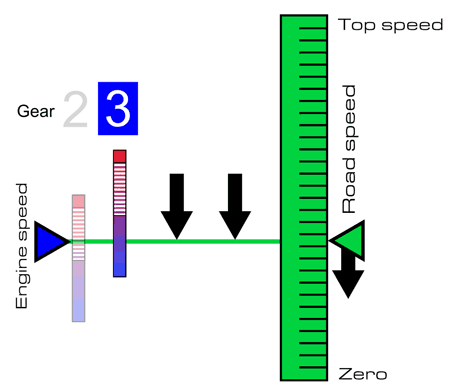
Rev matching is a technique used to prevent unnecessary weight transfer during down-changes in a manual transmission car. For a demonstration of why this concept is useful, select third gear and accelerate to about 3000rpm, then quickly select second and release the clutch fairly rapidly. You'll notice a large forward weight transfer as the engine speed is forced to increase. This can also cause the driving wheels to lock in extreme situations. Rev matching will make you a much smoother driver when changing down through the gears, a skill which is useful for the track and can lead to faster lap times. This technique is performed by depressing the clutch, selecting the required lower gear, increasing the throttle, and then releasing the clutch smoothly. You'll need more revs if changing from forth to second that from fourth to third. With practice, this can result in very rapid and very smooth changes, and is almost essential if driving on the track. Rev matching can also be performed while braking, this is known as heel and toe. When you first start to learn this technique, you might find it hard to predict the amount of revs you'll need for each gear, but remember any increase in revs is better than none.
Dedicated article on rev matching
Combining acceleration, braking, and steering
Smooth driving is most important when driving near the limits of your car. When you're taking a tight corner at high speed, the slightest press of the brake or accelerator pedal is likely to result in loss of traction. Graphs 5 and 6 consider the grip demands on a car during the process of cornering on the track. In Graph 5, the driver has separated out the acceleration, braking and steering elements of the corner, which won't yield the best lap times but will increase safety.

Graph 6 shows a driver who is combining steering with both the braking and acceleration elements of the corner in an attempt to gain better lap times. Steering while braking into a corner is known as trail braking and is an advanced technique, however accelerating at the latter stages of the corner is more commonly used. Great care should be taken when performing these actions, as the combined demands of the lateral and longitudinal forces on the tyres is much more likely to exceed the limits of grip (the yellow dots below).
Learn more about the science of grip here