Grip is a wonderful thing. It keeps you on the road, it allows you to accelerate, turn corners, and then stop again. However, there is a limit to tyre adhesion and this, sir, is the limit of your car. It's essential to have a grasp of the basic science behind grip if you want to drive on the limit. First, let's think about the contact patch of a tyre - this is the rubber which is actually in contact with the ground at any one time when you're driving along.

The contact patch
This little area of rubber can only supply a finite amount of grip, and for the purpose of explanation this is divided between the front to back (longitudinal) and side to side (lateral) directions. Longitudinal grip is used up when you're accelerating or braking, and lateral grip when you're turning corners and steering.

Here's the key point - if you are using all the available grip in one direction (e.g. braking), you will not have any available in the other (e.g. steering).
Combining lateral and longitudinal forces
When first learning to drive fast on the track, it's sensible to perform the most grip-demanding longitudinal and lateral actions separately. For example, when you're accelerating or braking hard on the straight, try to reduce steering inputs to the minimum. Applying this thinking to a corner means braking hard in a straight line, then releasing the brake fully before turning the steering (as shown in Graph 1 below). Performing these actions will reduce the grip demands on the tyres and provides a buffer of reserve grip which can be used should things start to go wrong.

Professional racing drivers tend to combine some of the lateral and longitudinal driving elements in an effort to extract every last bit of performance from their car. Combining the braking and steering elements of a corner is known as trail braking and it places very high demands on the tyres. Graph 2 shows how the braking and steering forces are added together to provide the total grip demand. In this case, the driver has misjudged the limits of grip and is now sliding out of control (a common mistake).

Good drivers know how to get the balance of all these forces right, especially when cornering, accelerating and braking hard. When driving near the limit it's vitally important drive as smoothly as you can, as the slightest driver input (such as a dodgy gear change) can exceed the total grip reserve and leave you heading towards the crash barriers.
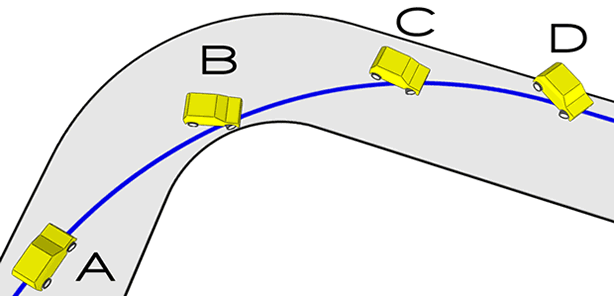
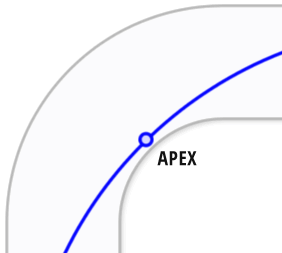
Learn more about track corners and the racing line here
Weight transfers and grip
As usual, life is not quite as simple as it first appears, and it may surprise you to learn that the total amount of grip available is not fixed. It in fact depends on a number of factors - one of which is the amount of weight acting on the wheel. If you decrease the amount of weight acting on the contact patch, this artificially lowers the amount of adhesion available, and vice versa. If you're accelerating hard, you will have less grip at the front end, more if you're braking (due to the weight transfers). Photo 1 shows a dramatic sideways weight transfer which has caused the inside rear wheel to lift, leaving no grip available at all. Please see the dedicated article on weight transfers for more information on how traction is affected by driver input.

Maximising traction
The best way of maximising your car's grip is to drive using smooth driving techniques. The way you change gear and use the throttle, brakes and steering can increase or decrease the amount of traction available. The best racing drives are usually the smoothest, and this mantra applies equally well to all driving disciplines.
Increasing grip
Grip can be increased in a number of ways, all of which are relatively easy to do Grip can be increased in a number of ways, all of which are relatively easy to do. Adding aerodynamic down force such as spoilers, and splitters to a car can increase the amount of available grip by diverting the force of high speed air to your advantage. But beware of cheap spoilers which can be designed as a styling feature only - and if you are planning on fitting an aftermarket spoiler to your car ensure there is enough strength available in the bodywork as some key areas may need reinforcing. Secondly, swapping your standard tyres for more specialist rubber can increase grip in certain conditions. For example, softer compounds usually provide better adhesion on racing circuits, however they usually wear out quicker - it's all a matter of compromise, so pick tyres which best suit your overall usage.
Grip and conditions
The final point is to remember that your tyre is only 50% of the traction equation when driving, the other 50% is made up of the surface of the ground. Dry tarmac provides dramatically more grip than when wet, and grip even varies between different tarmac types. Ensure you adapt your driving style to suit the conditions, and are constantly aware of the external environment. It's sensible to seek advice from an experienced driver before attempting an unfamiliar circuit for the first time.
Let's end with a nice slow motion video of a drag racer's tyre deforming as it accelerates - you can clearly see the fine balance between grip and slip.
https://www.youtube.com/embed/h1BlJxvzWIY